Isha at 11pm: how prayer apps handle summer nights in the UK
In a UK summer the sun never sinks far enough for the usual Isha angle, so prayer apps cap Isha with a high-latitude rule. All three rules, for London.
In a British summer, Isha moves late because the sun never goes far enough below the horizon for the twilight to end, and for several weeks it does not go far enough for most calculation methods' Isha angle to be reached at all. When that happens a prayer app does not measure Isha, it substitutes a rule: Middle of the Night, One-Seventh of the Night, or an angle-based share of the night. Each rule gives a different time, so two apps set to the same method can show Isha more than two and a half hours apart. That is not either app getting it wrong; they have chosen different rules.
This post explains what each rule computes, prints all three for one London night, and shows where the setting lives in PrayerTimes Pro, the studio's menu-bar prayer app for macOS, which offers all three. It does not tell you which rule is correct. That is a question for the scholars and the mosque you pray with.
Why the sign disappears
Most calculation methods define Fajr and Isha by a depression angle: the time when the sun is a fixed number of degrees below the horizon. The Muslim World League uses 18° for Fajr and 17° for Isha; ISNA uses 15° for both (praytimes.org, "Calculation Methods").

The further north you are, the shallower the sun's dip at midsummer midnight. In central London (51.5°N) the sun does not get far enough below the horizon to reach 17° in midsummer. I ran PrayerTimes' calculation engine day by day through 2026 for central London, and it finds no 17° time at all from 29 May to 15 July, and no 18° time from 23 May to 21 July. A 15° angle is still reached on 21 June, but only just. ISNA's unadjusted Isha falls at 00:49 BST and its Fajr at 01:15, which leaves 26 minutes between them.
Edinburgh (55.95°N) has it worse. By the same engine, even a 12° angle is never reached there from 2 June to 11 July 2026.
The calculation notes on praytimes.org put it plainly: at higher latitudes, "twilight may persist throughout the night during some months of the year" (praytimes.org, "Calculation"). Ask the formula for a time that never comes and it has no answer. Something else has to supply one.
The three rules apps use
Each rule divides the night, measured from sunset to sunrise, and sets a limit that Isha may not be later than and Fajr may not be earlier than. The open-source Adhan library words two of them that way: under One-Seventh, "Isha will never be later than the end of the first seventh of the night" (adhan-swift, HighLatitudeRule.swift).
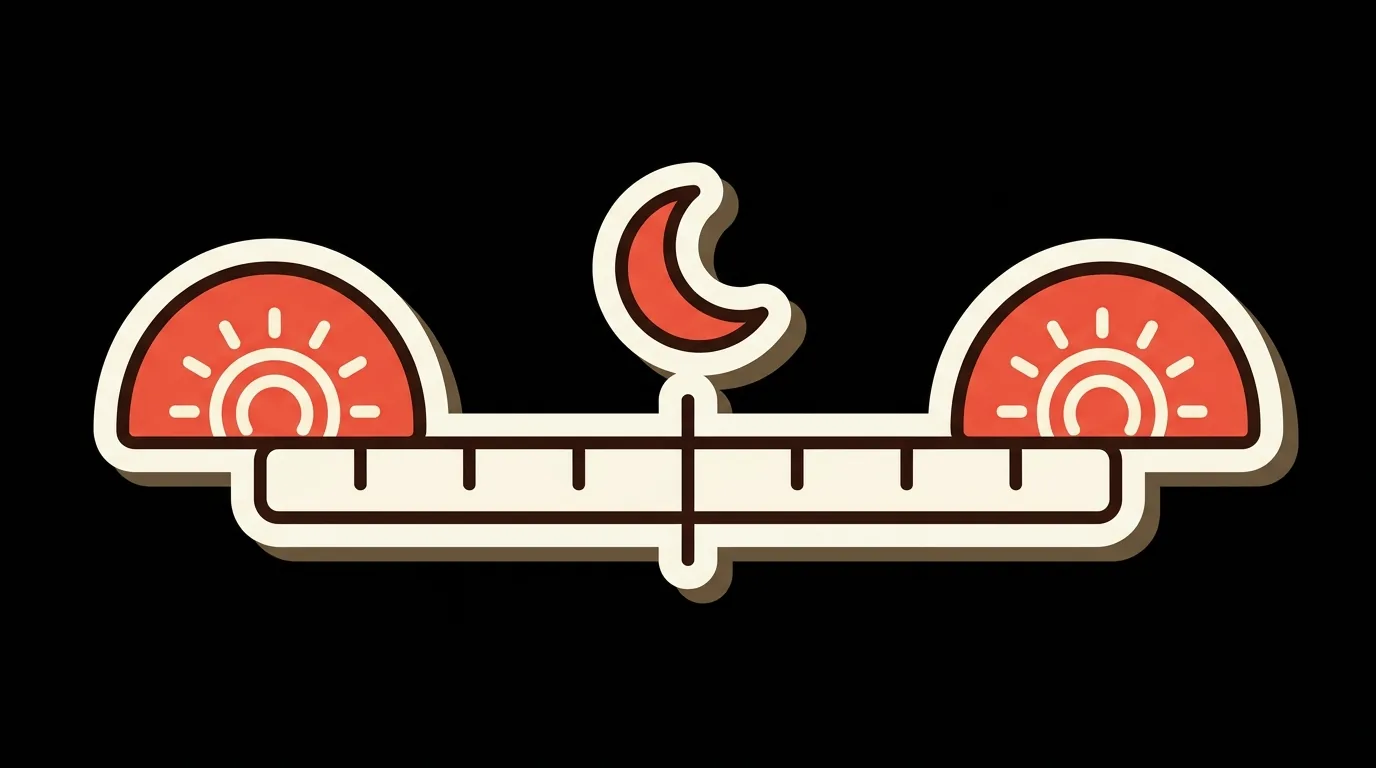
The rule is a ceiling, not a replacement. When the angle gives an earlier Isha than the rule's limit, the angle wins. That is why the rules change nothing in winter and only take over in summer.
Middle of the Night
"The period from sunset to sunrise is divided into two halves. The first half is considered to be the 'night' and the other half as 'day break'. Fajr and Isha in this method are assumed to be at mid-night during the abnormal periods" (praytimes.org).
When the angle is never reached, Isha and Fajr meet in the middle of the night. This is the latest Isha and the earliest Fajr any of the three rules allows.
One-Seventh of the Night
"The period between sunset and sunrise is divided into seven parts. Isha begins after the first one-seventh part, and Fajr is at the beginning of the seventh part" (praytimes.org).
With any of the usual angles, this gives the earliest Isha and the latest Fajr of the three. Adhan's recommended(for:) function picks this rule above 48° latitude and Middle of the Night below it (adhan-swift).
Angle-based
"Let α be the twilight angle for Isha, and let t = α/60. The period between sunset and sunrise is divided into t parts. Isha begins after the first part." So "if the twilight angle for Isha is 15, then Isha begins at the end of the first quarter (15/60) of the night" (praytimes.org). Fajr works the same way from the other end, using the Fajr angle.
This falls between the other two, and it moves with the method. MWL's 17° Isha gives 17/60 of the night, a little over a quarter. ISNA's 15° gives exactly a quarter.
One night, three answers
These are the times for central London (51.5074°N, 0.1278°W) on 21 June 2026, in British Summer Time. I computed them with the calculation engine that ships in PrayerTimes 5.1.0, with no minute adjustments. Sunset is 21:22 and sunrise 04:43, so the night is 7 hours 21 minutes long.
Muslim World League (Fajr 18°, Isha 17°). Neither angle is reached that night, so the rule alone sets both times:
| Rule | Isha | Fajr |
|---|---|---|
| Middle of the Night | 01:02 | 01:02 |
| One-Seventh of the Night | 22:25 | 03:40 |
| Angle-based (17/60 and 18/60 of the night) | 23:27 | 02:31 |
ISNA (15° and 15°). Here the angle is reached, if only briefly:
| Rule | Isha | Fajr |
|---|---|---|
| Middle of the Night | 00:49 | 01:15 |
| One-Seventh of the Night | 22:25 | 03:40 |
| Angle-based (a quarter of the night) | 23:12 | 02:53 |
The arithmetic checks out by hand. A seventh of 441 minutes is 63, and 21:22 plus 63 minutes is 22:25. Under ISNA with Middle of the Night, the real 15° times (00:49 and 01:15) already fall inside the midpoint limit, so the rule leaves them alone.
Six months later, on 21 December 2026, the same engine gives MWL's Isha at 17:51 and Fajr at 05:59 under all three rules. The angles are reached comfortably, so no rule applies.
The spread is the point. On one night, in one city, with one method, Isha can be 22:25 or 01:02 depending on a setting most people never open.
From the studio: In PrayerTimes Pro that setting is one row in the calculation settings, with all three rules and a Recommended option that picks by latitude, and the menu-bar countdown follows whichever you choose.
Methods that bring their own answer
Not every method uses these three rules. The Moonsighting Committee holds that "no fixed degrees can be used for Fajr & Isha", because its research found that dawn and dusk twilight "are functions of latitude and seasons" (moonsighting.com, "How We Calculate Muslim Prayer Times"). Its high-latitude policy, from the same page:
- At 55°, the 18° times are "compared with the values given by the functions of latitude and seasons and most favorable values are used".
- Between 55° and 60°, "the rule of Sab'u Lail (1/7th of the night), is used because other methods give times that become hardship".
- Above 60°, "we slide down to 60degrees and calculate Fajr & Isha using the rule of Sab'u Lail in summer".
- Above 65°, "the sun does not set/rise for a number of days every year".
For London on 21 June 2026 the Committee's method gives Maghrib at 21:25, Isha at 22:42 and Fajr at 02:43. Those times are the same whichever high-latitude rule is selected, because the method's own seasonal model is doing the work. In Edinburgh, above 55°, it gives Isha at 22:58 and Fajr at 03:31. Those are exactly the One-Seventh times, as the page says they should be.
The method also asks which twilight has to disappear before Isha begins: the red glow (shafaq ahmar) or the white glow that follows it (shafaq abyad). That is a long-standing difference within the Hanafi school, and this question on islamqa.org is a good place to see it discussed by people qualified to discuss it. In minutes, for London on 21 June, Isha by the white twilight falls at 23:52, against 22:42 by the general setting.
When Isha ends, not only when it starts
Late summer evenings raise a second question: how long the chosen time for Isha lasts. Two common positions measure it as a share of the night, this time from Maghrib to the next Fajr:
- First third of the night, which the PrayerTimes settings label as the Maliki, Shafi'i and Hanbali position.
- Islamic midnight, half the night, which the settings label as Hanafi.
With the Moonsighting Committee in London on 21 June 2026, Maghrib is at 21:25 and the next Fajr at 02:43, which makes the night 5 hours 18 minutes. The first third ends at 23:11 and Islamic midnight at 00:04. If you follow the white twilight, Isha begins at 23:52, which leaves twelve minutes before midnight. That is the arithmetic, not a ruling. It is also the situation behind questions like this one on islamqa.org, which begins: "Maghrib prayer time goes as late as 2145 at night which means that Isha will be quite late". Darul Ifta Birmingham answers another, from someone combining the two prayers "due to no valid Esha Shari' time in the summer".
Those pages carry the rulings. An app can only carry the arithmetic.
Setting it in PrayerTimes
PrayerTimes Pro is the studio's menu-bar prayer app for macOS 14 and later. Everything below is in Settings → Prayer Times → Calculation, and these are the labels in version 5.1.0:
- Method. On Automatic in the UK or Ireland, the app picks the Moonsighting Committee. You can pick any of the twenty-six methods by hand instead, and the row shows which one Automatic currently means.
- High Latitude Rule. The options are Recommended, Middle of the Night, Seventh of the Night and Twilight Angle. Recommended picks Seventh of the Night above 48° latitude and Middle of the Night below it. The row's own subtitle says it "matters above about 48° latitude, where twilight can last all night in summer". As the London figures above show, it changes the angle-based methods. The Moonsighting Committee keeps its own seasonal times.
- Hanafi Madhhab (for Asr). Besides moving Asr later, this switches the Moonsighting Committee's Isha to the white twilight, so it is the switch behind the 22:42 versus 23:52 difference above.
- Isha Ends At. Choose First third of the night or Islamic midnight. If you never set it, it follows the Hanafi switch.
- Time Correction. This nudges any single prayer by whole minutes. Use it when your mosque publishes a timetable and you want the countdown to agree with it.
If you travel north for the summer, crossing a time zone makes the app ask for a fresh location, so the times follow you rather than staying on the old city.
One honest caveat. PrayerTimes does not claim to reproduce any mosque's or authority's printed timetable. When someone reports a gap against an official one, it goes on the public issue tracker. Three such reports are open as I write: Riyadh, Morocco and Jordan. The app is free; Pro is a single $14.99 purchase, not a subscription.
Ask your mosque which one
Every number in this post comes from geometry and a policy choice. The geometry is settled. The choice is not, and it is not an app's to make. A mosque that publishes a summer timetable has already chosen a method and a way of handling the summer weeks. Ask which one it uses, set the same in whatever app you use, and use the minute corrections to close any remaining gap. If your community has not settled the question, the scholars it trusts are the right people to ask. A settings screen can only do what you tell it.
If the app on your Mac is PrayerTimes Pro, the settings above are where that answer goes.
Never look up from work and realise you missed Asr.
Prayer times in your Mac's menu bar — a quiet countdown in the corner of your eye, alerting you gently or with the adhan you grew up hearing.
Free$14.99 PromacOS 14+